

Learning
How to Learn
Optimize Your Learning of Anything
 |  |
One of the most important skills in life to master is the Art of Learning itself.
Learning how to learn begins with Basics and continues with basics.
3 basic Colors can make millions of pictures.
10 basic Digits can make millions of numbers.
8 basic Strokes can make millions of Chinese books.
26 basic Letters can make millions of English books.
Basic Listening & Speaking followed by Reading & Writing makeup millions of University level teachings.
Pattern Recognition, Simplicity, Timing, Context and being Multilingual are just some of the tools for learning how to learn.
Learning Optimization
– Create a Structured Learning Schedule dedicating specific time to different wealth-building topics
– Implement the 80/20 rule – Focus on the 20% of Content that delivers 80% of Results
– Take Actionable Notes and Implement 1 New Strategy Each Week
– Diversify your Learning across different Perspectives to avoid echo chambers
– Balance Theoretical Knowledge with Practical Implementation
– Join Community Discussions in the comments sections for additional insights
– Revisit Foundational Content periodically as your understanding deepens
– Combine YouTube Learning with Book Reading for comprehensive education
Learning System
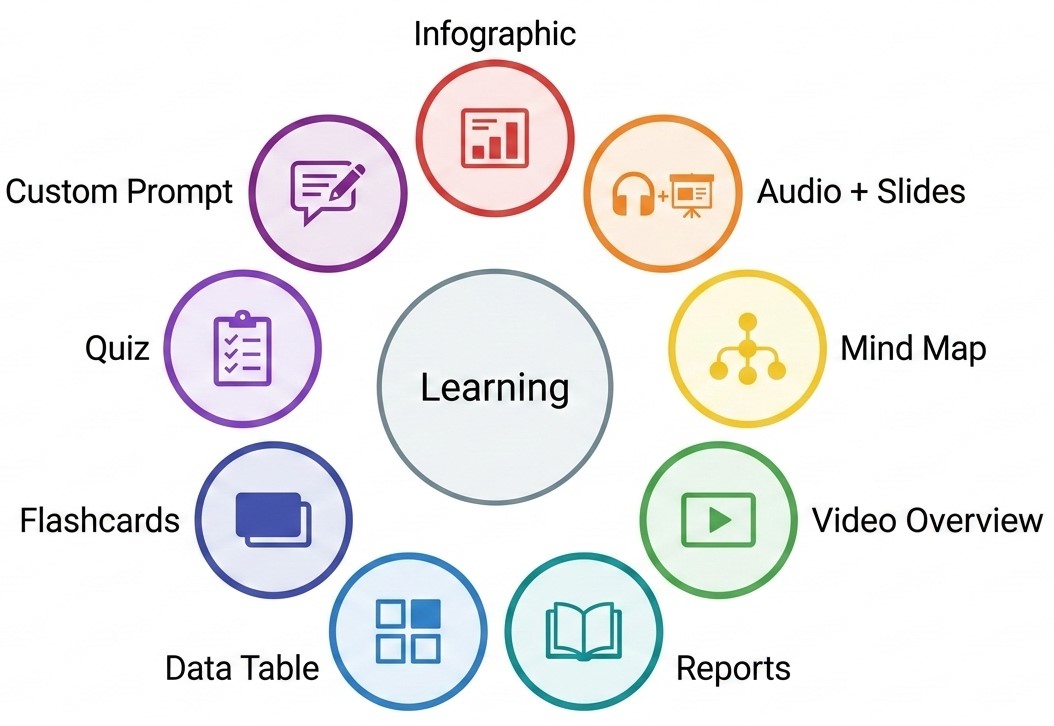 |  MultiMedia |
Learning System
Greetings, Student to a Philosopher’s Stone of Pedagogy: universal solution for ignorance. Welcome to our Learning System – workflows that distills any subject into a MasterClass
Combining Notebook LM (your personal, tireless research assistant) with wisdom of 5 Masters:
– Einstein intuitive, visual foundation-building.
– Montessori hands-on, sensory engagement & self-directed discovery.
– Feynman ruthless simplification & clarity.
– Socrates sharpening mind through relentless questioning.
– Robinson unlocking creativity, finding connections & divergent thinking.
Curiosity
Before we build a house, we need a blueprint. Before we set out a large journey, it’s helpful to have a map. Diving into details without a framework is a path to confusion.
Goal Build an intuitive, visual & tactile model of entire subject. Know where everything lives & feel its shape.
With Your Tool Notebook LM,you will create your own MasterClass Notebook This can be a physical binder, digital folder or note-taking app. In this phase, we fill it with 3 Critical Documents:
Big Picture Infographic
- Input Take syllabus, table of contents or a high-level overview of your subject.
- Process Ask your Notebook LM to generate a single, clear infographic. It must show subject as a central sun, with 3 to 10 major principles or branches as planets orbiting it. Key terms could be moons.
- Output A visual solar system of knowledge. Pin this above your study area.
Exploratory Mind Map
- Input Relevant, helpful source material.
- Process Create a radial map. Start with central concept. Branch out to main categories. For each category, branch out to key ideas, questions & notable figures. This isn’t about memorizing facts; it’s about connecting territories.
- Output Roadmap of subject’s landscape. You now know capital cities & major highways of knowledge before you’ve visited them.
Prepared Environment & Tangibles (Montessori’s Gift)
- Input Your Mind map & Infographic.
- Process Curate your physical & digital space. Gather objects, images, sounds or simple physical models that represent core ideas. If learning biology, have a leaf, a bone & a seed. If learning physics, have a magnet, a prism & a pendulum. Arrange them so they are visible & accessible.
- Output A learning space that invites exploration & gives abstract concepts a physical anchor. Your hands now have a role.
Einstein’s Wisdom “If you can’t explain it simply, you don’t understand it well enough.” Montessori’s Wisdom “The hands are the instruments of man’s intelligence.” At this stage, you are charting territory & preparing the ground so details have a place to live & a shape to hold.
Exploration
Now a Map. It’s time to visit each city, 1 at a time. We will use this powerful tool for deep understanding, teaching & optimizing.
Goal Deconstruct each core concept from mind map into its simplest, most fundamental truth & give it a tangible form.
Your Tool (Your Notebook LM) We will now generate a series of “Feynman-Montessori Explorations.” For each node on your mind map, you will create one of these.
- Concept Choose one core idea from your mind map (e.g., “Supply & Demand” in Economics, “Krebs Cycle” in Biology).
- Explanation (Write it down) On a new page in your notebook, write name of concept at top. Now, explain it in plain, simple language as if you were teaching it to a bright 8 year old. Use analogies. Avoid jargon. If you get stuck or use complex terms, that’s a gap in your own understanding.
- Refinement Go back to your source material & fill those gaps. Then rewrite explanation more simply. Repeat until you have a clear, concise & jargon-free paragraph or 2.
- Analogy Engine For bonus points, ask your Notebook LM to generate a powerful analogy for this concept. “A bank is like a value locker for your money, giving you interest as rent for using it.” Analogies are glue of memory.
- Hands-On Work (Montessori’s Addition) Create a simple physical or drawn representation of this concept. For Supply & Demand, draw a simple graph with blocks. For Krebs Cycle, use colored clay to shape each molecule. Play with it. Explain it while touching it.
Feynman’s Wisdom “The 1st principle is that you must not fool yourself — and you are the easiest person to fool.” Montessori’s Wisdom “What the hand does, the mind remembers.” This process exposes ignorance & engraves understanding through touch.
Questioning
Understanding is not enough. Knowledge must be durable, testable & defensible. You must be able to wield it & reimagine it. For this, we turn to master of dialectic & master of creativity.
Goal To stress-test your understanding, uncover hidden assumptions, build ability to reason with knowledge & generate new possibilities.
Your Tool (Your Notebook LM) We will generate 3 powerful tools from your Feynman-Montessori Explorations.
Socratic Dialogue
- Input One of your completed “Feynman-Montessori Explorations.”
- Process Create a script between a Master & a Student. Student asks naive but fundamental questions about concept. Master must answer using only knowledge from your exploration. This forces you to think dynamically.
- Example for “Supply & Demand”
– Student “Why does price go up when there’s less stuff?”
– Master “Because people who want stuff have to compete for it by offering more money.”
– Student “But what if thing is really important, like medicine?”
– Master “That’s ‘inelastic demand.’ People will pay almost anything, so price can go very high.”
1st Principles Simplified
- Input A claim, theorem or conclusion from subject.
- Process Ask “Why?” repeatedly, like a stubborn child, until you arrive at a fundamental, undeniable truth (a 1st principle). This builds your reasoning from ground up.
Divergent Thinking Prompts
- Input Same concept.
- Process Ask “What if?”, “How might this be different?”, “What does this connect to that seems unrelated?”. Generate multiple possibilities, metaphors across domains & creative extensions. There are no wrong answers, only new connections.
- Example “What if supply & demand worked in reverse? What would that world look like?”
Socrates’ Wisdom “I cannot teach anybody anything. I can only help them think.” Robinson’s Wisdom “Creativity is as important as literacy.” This phase makes you think & imagine, forging neural pathways that passive reading could not.
Blueprint
You have map. You have explored cities. You have debated & reimagined their design. Now you must build your own Wisdom Temple.
Goal To synthesize all individual concepts into a single, coherent, personal, & creative representation of entire subject.
Your Tool (Your Notebook LM) We create final, master document.
- Master Project Create a new, single document. Its title is name of subject.
- Synthesize, Don’t Copy Import your Big Picture infographic. Then, 1 by 1, take your Feynman-Montessori Explorations, Socratic Dialogues, & Divergent ideas, refine them, & weave them into document under appropriate headings from your original mind map.
- Connect Dots As you add each piece, write a short paragraph on how it connects to other pieces in system. “This concept of Supply & Demand connects to idea of Market Equilibrium, which we discussed earlier, because…”
- Your Voice & Creative Synthesis (Robinson’s Addition) Add your own thoughts, questions & analogies you liked best. Also add a section “Creative Extensions” – write a short piece, a poem, a dialogue or a sketch that expresses the subject in a new way. This is now your book on subject, written by you, for you & imagined by you.
Map
A building needs to be inspected. Knowledge needs to be tested. This is not for a grade, but to find cracks in your Temple before they cause it to collapse.
Goal To ruthlessly identify weak points & fortify them through active recall, application & creative demonstration.
Your Tool (Your Notebook LM) We generate 3 final assessment tools.
Flashcard Cascade
- Input Key terms, definitions & concepts from your Master Project.
- Process Generate a comprehensive set of flashcards. But don’t just do simple definitions. Use Socratic questions “What is first principle behind…?” or “Explain analogy for…” or “What happens to X if Y changes?” Add Robinson-style prompts “Give a metaphor for this from nature” or “How would you teach this to an alien?”
- Output A deck for spaced repetition software (like Anki) or physical cards. Review Daily.
Mastery Exam
- Input Your entire Master Project.
- Process Generate a rigorous, multi-format exam.
- A Concept Definition (Short Answer) Test core ideas.
- B Scenario Application “Given [Situation A], what would be outcome according to [Theory B]?” This is pure Socrates.
- C “Connect Dots” Essay “Explain how [Concept 1], [Concept 2] & [Concept 3] interact to form foundation of this subject.”
- D Creative Challenge (Robinson’s Addition) “Design an experiment, a story or a product that applies this subject in a real-world context.”
- Reporting Take exams closed book & open book. Grade it clearly. Every wrong answer is not a failure, but a discovered gap in Temple. Go back to Exploration or Questioning for that specific concept & patch hole.
Teaching & Exhibition
- Input Your Master Project & your physical Models.
- Process Teach the subject to someone else (or even an empty chair) using your words & your hands-on materials. Explain, demonstrate & answer questions. Record it or reflect on what felt shaky.
- Reporting Where did you stumble? Where did you need your materials? That is a gap. Return & Refine.
Final Wisdom This workflow is a circle, not a line. When exam reveals a gap, you return to Feynman-Montessori phase, then Socrates-Robinson phase, update your Master Project, & create new Flashcards. With each cycle, subject becomes a part of you – known in your Mind, Hands, Imagination & Spirit
Now. What subject shall we Master first?
Learning Languages
Pick Only Languages that You Find Interesting (even if you think they’re too difficult to Start with)
Listen to That Language All the Time (even if it’s just Singing Along in that language)
Change Media Settings to That Language (to see it as much as possible)
Talk to Yourself and Practice Words, Phrases and Pronunciation Constantly
Practice with Native Speakers Every Opportunity You Can (or non-native)
Study in the Best Possible Environment for You
Use Flashcards, Apps, Acronyms, Acrostics, Games and other Study Tools to allow it faster and easier
Reflect on What You’ve Learned and Always Review to stay inspired
Learn a Book Quickly
Scan Cover
Table of Contents
Introductory Chapter
Last Chapter
(Preface)
Appendices
Epilogues
See if Author Pulled It Off & How
Read it Backwards & Keep Moving Fast
Present it in 5 Minutes
Teach the Table of Contents
Teach the Main Wisdom & some Lessons Learned
Learn Chinese in 88 Days
Proven Techniques to Achieve Fluency in Record Time
.
Effective strategies and techniques to accelerate your language learning journey
Discover proven methods used by top Polyglots, Military Linguists and Rapid Language Learners to achieve conversational fluency in Chinese in less than 3 months. This comprehensive guide combines Proven Techniques with Practical Strategies used by the world’s most successful language learners.
Best Practices for Rapid Language Learning
Clarify Your Why
Define your core inspiration for learning Chinese. Write it down and review it daily to maintain focus and commitment throughout the 88 days.
Remember Why you want to learn this language
Practice gratitude and appreciation in that language constantly
Mindset Transformation
Identify, reframe and transform limiting beliefs and fears about language that are in your way of learning through daily afformations.
Learning Systems
Identify and focus on high-frequency vocabulary and essential grammatical structures.
Use Strategic Shortcuts, Tips, Tricks and Summaries to Leverage Time!
Pattern Recognition – Organize vocabulary into themes and patterns for easier memorization
Word Categorization – Categorize the words together with words you already know
Mnemonic Devices – Use Acronyms, Acrostics and vivid mental images to speed things up and memorize characters and tones
Better organization of vocabulary in your mental lexicon
Assessment of Your Present Level
Consistent & Dedicated Practice
Practice as much as possible
Practice communicating in that language with simple Quizzes of Listening, Speaking, Reading & Writing
Accelerated acquisition through constant exposure & engagement, cognitive organization & enhanced memory retention for complex language
Practice 2 hours a day minimum
Repetition Practice – Listen carefully to what is important to pronounce correctly and practice all day long, Repeating what you hear over and over out loud, in your head and on paper
Practical Application – Shop, Order things online & Use in interactions
Real-world language use in practical situations
Enhanced memory retention and recall
Cultural Integration
Learn interesting stories from elders of the language
Translate your favorite stories into that language and share them
Philosophical Foundation
Study Chinese philosophy and cultural concepts to understand the language’s underlying worldview.
Understand the philosophy behind the language
Learn the philosophy of that culture as a base
Total Immersion
Constant Immersion in the culture 24 Hours a Day. Surround yourself with the language at all times – change device languages, listen to Chinese radio and label your environment.
Listening Immersion
Listen to Music constantly, sing it out loud and memorize the lyrics, even if you don’t understand all the words initially.
Background Learning, Play Music or Podcasts in the background constantly
Environmental Labeling
Have visual cues such as stickers and labels on everything in your environment with both characters and pinyin for constant visual reinforcement.
Enjoyable Learning
Make it Fun!
Leverage time combining fun learning together such as practicing a language while doing a sport!
Gamified Flashcards
Create & Build Flashcard decks with SRS (Spaced Repetition System) and play them as a game to make it fun, treat reviews as a daily game with rewards.
Visual Association, Connect every word to a picture
Efficient & Enhanced vocabulary retention through visual memory with minimal effort
Shadow Technique
Active Repetition – Listen to native phrases and repeat them immediately with matching intonation and rhythm.
Response Training
Practice responding rapidly
Expertise Transfer
Use your existing professional knowledge as context for learning Chinese terminology.
Choose disciplines that you already have expertise in as study guides
Teach to Learn
Teach the language, Explain Chinese concepts to others as often as possible, even as a beginner, to reinforce your own understanding.
Dream Journaling
Dream in that language.
Keep a journal by your bed to record any Chinese words or phrases that appear in your dreams.
Chunk Learning
Listen to & Focus on learning complete phrases at a time rather than isolated words by themselves for more natural communication.
Personal Phrasebook
Create a customized dictionary of phrases that you use frequently or are relevant to your daily life and interests.
Use apps such as dictionaries and thesauruses along with modern AI tools
Family Immersion
Ask all of your loved ones to speak with you in this language whenever possible.
Community
Engage with others to accelerate learning.
Write Letters & Get Feedback
Color-Coded Learning
Use Color Systems to denote word Tones, grammatical Functions or word Categories.
Curated Content Playlists
Create automated playlists of content most relevant today in your life and the lives of your loved ones
Content Subscription – Subscribe to Top Channels
Contextual Learning
Content Engagement
Reading interesting articles and content
Character Mastery
Learn 3.000 Most Common Characters
Learn artistic forms of calligraphy
Skill Integration
Learn new skills
Expert Engagement
Identify, Locate & Have Conversations with Experts
Interview experts who have the most expertise in the world at the thing you want to learn most
Specialized Guidance
Sentence Practice
Practice course sentences
Group Study
Form study pods to practice and take small group classes to learn in masterminds
Study pod of 8 to 12
Mastermind Accountability Group
Direct Thinking
Think in that language rather than translating to it
Self-Monitoring
Listen to yourself and learn to edit
Reading Practice
Read along out loud
Progressive Challenge
Automatically increase your speed a little bit at a time
Pronunciation Comparison
Record yourself and compare it to a native speaker
Test yourself by have live conversations with native speakers
Digital Resources
Use online platforms
Structured Learning
Create a study schedule and set objectives
Daily review of priorities and new learnings
Conversation Accountability Partnership
Find a language partner using the same program to have Conversations with for daily practice sessions and mutual encouragement.
Vocabulary Organization
Create word lists
Error Correction
Enjoy correcting your errors
Clarification Seeking
Ask for help with difficult words
High Value
Rehearse phrases that will increase prosperity for you and your loved ones.
Ready to Speak Chinese in 88 Days?
Join thousands of successful learners who have achieved conversational fluency in less than 3 months
“The limits of my language mean the limits of my world. Learning Chinese expanded my world exponentially in just 88 days.”